Managing the Thermal Resilience of Streams in the Face of Climate Change
By: Hailey Smith, PhD Candidate, School of the Environment, Washington State University
The Yakima River Basin (YRB) mirrors environmental problems reflected across the Columbia River Basin, including decaying water quality, more frequent droughts, and a decrease in viable habitat for endangered and culturally important aquatic species, such as salmon.
In the YRB, climatic changes in precipitation, air temperature, and snowpack are causing reduced stream flow and increased surface water temperatures that exceed the thermal limits of salmonids and other cold-water species (Hardiman & Mesa, 2014; Kock et al., 2019; Wagner et al., 2021). Managers are actively looking for ways to protect critical waterways from experience extreme increases in temperature, and one option they are exploring is the use of more effective shade through the restoration of riparian vegetation.
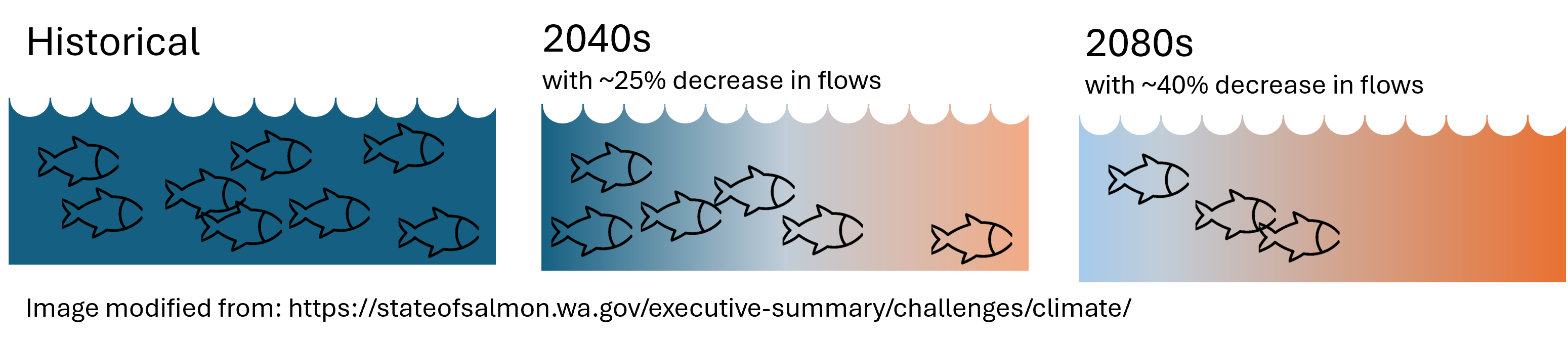
Does implementation of effective shade through restoration of riparian vegetation on targeted tributaries have the potential to reduce projected river warming in the Yakima River Basin? Through this work, we will focus on exploring options for improving tributary temperatures that impact the temperature of the Yakima River and the confluence of the Yakima with the Columbia River. This study will use the NorWeST Stream Temperature Model framework (Isaak et al., 2017) and will simulate the impacts of three different climate scenarios on river temperatures in three different riparian vegetation scenarios co-developed with natural resources managers to evaluate the potential cooling from targeted restoration in the YRB.

Hailey Smith
Research interests: Impact of climate change on future river temperatures, targeted riparian restoration strategies
Advisor: Julie Padowski
This work was funded in part by: